Questions to Ask Your Builder: Top 10 Non-Negotiable Questions Before Booking a Property in Navi Mumbai
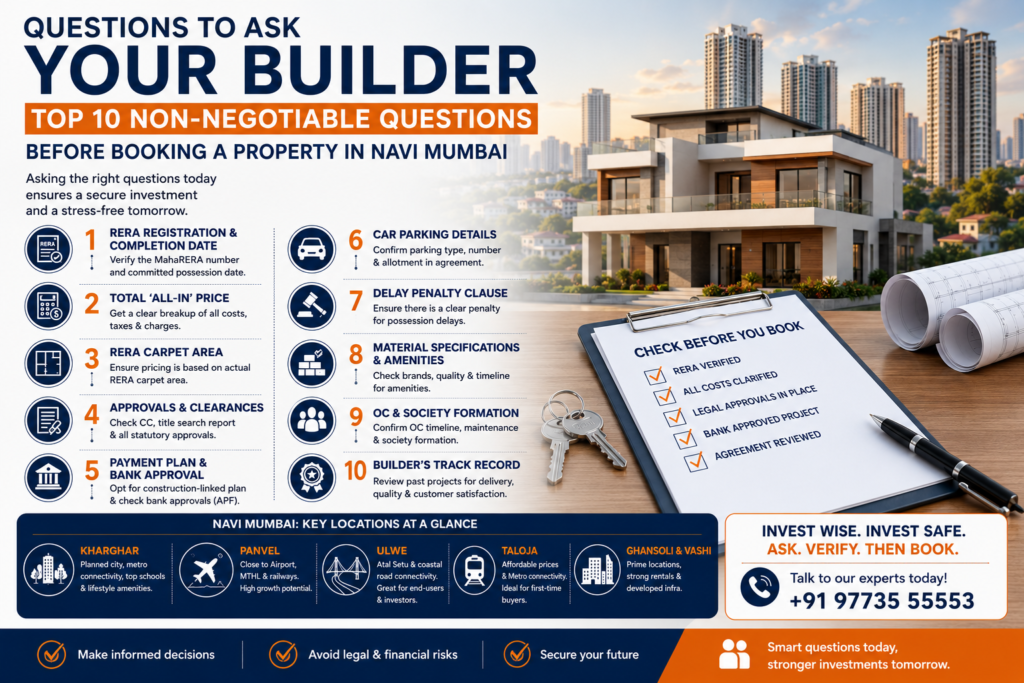
The real estate landscape in Navi Mumbai is undergoing unprecedented growth. Major infrastructure developments—such as the Atal Setu (MTHL), the Navi Mumbai International Airport (NMIA), and expanding Metro routes—have transformed locations like Kharghar, Panvel, Ulwe, Taloja, and Ghansoli into prime residential and investment hotspots.
However, committing your hard-earned capital requires diligence. You should never rely solely on glossy marketing brochures or verbal commitments made by sales executives.
Whether you are a first-time homebuyer or an experienced real estate investor, asking the right questions before paying a booking deposit is essential. A single oversight can lead to project delays, unforeseen expenses, or complex legal complications.
Here is your definitive 10-point checklist of non-negotiable questions to ask your developer before signing any documentation or transferring funds.
The Ultimate Checklist: 10 Questions to Ask Your Builder
1. “What is the official MahaRERA Registration Number and committed completion date?”
Why this matters: Under Maharashtra real estate law, no developer can market, advertise, or sell a property without a valid MahaRERA registration.
- What to verify: Request the official registration number and cross-check it directly on the MahaRERA online portal.
- Crucial detail: Compare the verbal possession date given by the sales agent with the official RERA Completion Date. Remember that the date registered on the RERA portal is the only legally enforceable deadline.
2. “What is the total ‘All-In’ price, including all hidden or additional charges?”
Why this matters: Base rates per square foot rarely reflect the true cost of the property.
- What to verify: Request a comprehensive, written All-Inclusive Cost Sheet.
- Key cost factors to scrutinize:
- Stamp Duty & Registration fees (typically around 6–7% in Mumbai/Navi Mumbai).
- Applicable GST (1% for affordable housing, 5% for standard residential units).
- Development, infrastructure, and utility connection fees (water and electricity meters).
- Advance maintenance deposits (often collected for 1 to 2 years upfront).
- Club membership and amenities charges.
3. “What is the exact RERA Carpet Area of the apartment?”
Why this matters: Industry practices like quoting “Super Built-Up Area” or “Saleable Area” can be misleading. Under RERA regulations, property pricing must strictly correspond to the usable Carpet Area.
- What to verify: Confirm the exact internal carpet area along with designated balcony, deck, and utility spaces.
- Pro Tip: If a brochure advertises 1,000 sq. ft. super built-up space, the actual RERA carpet area may only measure between 600 to 650 sq. ft. Ensure complete clarity on this metric before committing funds.
4. “Which municipal approvals and statutory clearances have been obtained?”
Why this matters: Issues regarding land titles or missing approvals from local authorities (CIDCO, NMMC, or PMC) are primary drivers of construction delays.
- What to verify:
- Commencement Certificate (CC): Ensure a valid CC has been issued for the specific floor you are purchasing. A developer cannot legally construct above approved limits without it.
- Title Search Report: Verify a minimum 30-year clear title search confirming that the land is free from encumbrances, litigation, or bank mortgages.
- CIDCO/NMMC Clearances: Confirm that land transfer, leasehold conversion, or development rights are fully cleared by local planning bodies.
- ⚠️ Red Flag Notice: If a builder requests a booking deposit claiming that the Commencement Certificate (CC) will be issued soon, withhold payment immediately. Investing prior to CC issuance carries significant risk.
5. “What payment structures are available, and which financial institutions have approved the project?”
Why this matters: Structured payment plans mitigate risk and ensure financial predictability.
- What to verify:
- Confirm whether the developer offers a Construction-Linked Plan (CLP), which aligns your payments directly with verified construction milestones.
- Ask for the project’s Approved Process Code (APF) from major nationalized and private banks (e.g., SBI, HDFC, ICICI, Axis Bank).
- Why it helps: Pre-approval by major financial institutions indicates that their legal teams have already audited the project’s title and compliance credentials.
- What to verify:
- 6. “What is the specific procedure for car parking allotment?”
Why this matters: Parking availability in the Mumbai Metropolitan Region (MMR) is a frequent source of post-handover disputes.
- What to verify:
- Clarify whether you are receiving covered (stilt/basement) or open parking.
- Ensure that the assigned parking space number is explicitly recorded in both the Allotment Letter and the formal Agreement for Sale.
- Note that under RERA directives, open parking spaces form part of common areas and cannot be sold independently by the builder.
- What to verify:
- 7. “What penalty clause applies if the developer delays project possession?”
Why this matters: Enforceable delay compensation safeguards your capital in the event of project timeline slippage.
- What to verify: Review the draft Agreement for Sale specifically for the Default and Compensation Clause.
- Legal Standard: Under RERA guidelines, if a developer fails to deliver possession by the registered date, they are legally obligated to pay monthly interest at a rate prescribed by RERA (typically SBI’s Highest Marginal Cost of Funds Based Lending Rate + 2%) for the duration of the delay.
- 8. “What are the exact material specifications, and when will amenities be delivered?”
Why this matters: Sample flats often feature premium upgrades that are not included in the standard apartment specifications.
- What to verify:
- Request a signed specification sheet detailing the exact brands and grades used for flooring, sanitary fittings, electrical wiring, and elevators.
- Clarify the delivery schedule for shared amenities (such as the clubhouse, gym, and swimming pool). Determine whether these will be completed alongside Phase 1 or deferred until final project completion.
- What to verify:
- 9. “What is the timeline for the Occupancy Certificate (OC) and Society Formation?”
Why this matters: Occupying a property without a valid Occupancy Certificate is illegal and leads to inflated municipal charges for water and electricity.
- What to verify:
- Confirm the developer’s commitment to secure the OC before handing over keys.
- Inquire about the estimated monthly maintenance fee per square foot.
- Ask for the prospective timeline regarding the formation of the Co-operative Housing Society (CHS) and subsequent land conveyance.
- What to verify:
- 10. “What is the developer’s track record across previous projects?”
Why this matters: A developer’s past performance is a reliable indicator of their capability and commitment to quality.
- What to verify:
- Review the delivery timelines and execution history of their prior developments.
- Visit an earlier completed project by the same builder to inspect construction durability, maintenance standards, and resident satisfaction.
- What to verify:
Navi Mumbai Real Estate Buying Guide: Key Locations Overview
Your purchasing strategy should align with the structural benefits of each micro-market within Navi Mumbai.
Kharghar features a master-planned layout anchored by Central Park, executive golf courses, robust Metro infrastructure, and prominent educational institutions, making it ideal for families and long-term end-users.
Panvel benefits significantly from its strategic proximity to the Navi Mumbai International Airport (NMIA), the MTHL connection, and major railway terminals, offering strong potential for capital appreciation and high returns for real estate investors.
Ulwe offers direct access to South Mumbai via the Atal Setu (MTHL) along with coastal road connectivity, making it a preferred location for working professionals seeking manageable commute times and reliable rental yields.
Taloja serves as an accessible entry point with attractive pricing structures and enhanced integration via Metro Line 1, catering well to budget-conscious first-time buyers.
Ghansoli and Vashi represent established commercial and technology corridors featuring prime residential developments, strong rental demand, and mature civic infrastructure for corporate professionals and premium buyers.
Summary Checklist Before Transferring a Booking Deposit
Prior to making any financial commitments, complete the following verification steps: Ensure the project’s RERA registration details are verified on the official MahaRERA portal. Secure a written, itemized cost sheet confirming all prospective expenses and fees. Verify that the RERA Carpet Area is explicitly documented and review the approved Commencement Certificate (CC). Confirm bank APF approval codes, ensure car parking details are specified in the draft agreement, and have the draft sale agreement reviewed by an independent real estate attorney.